RankYak vs Autoblogging.ai for CMS Integrations
You are choosing between RankYak and Autoblogging.ai because your CMS is where content actually ships. Picking the wrong integration means hours lost to copy-paste, broken formatting, and drafts that never make it to WordPress or your site builder. This comparison settles that decision.
You will see how each tool connects to your CMS, what its publishing workflow looks like, and how AI generation modes affect output quality. We break down features, pricing, and scalability, then name exactly who should choose Autoblogging.ai and who should choose RankYak.
Quick Verdict: RankYak vs Autoblogging.ai for CMS Integrations
If you need deep CMS integrations and flexible publishing workflows, Autoblogging.ai is the stronger choice; RankYak is better for simple, direct WordPress publishing.
Autoblogging.ai offers 35+ integrations, a list that includes WordPress, Shopify, Wix, and Zapier. That spread matters when your content operation touches more than one platform. RankYak, by comparison, is generally described as focusing primarily on WordPress, which keeps things simple but limits where your content can go.
Scale is another differentiator. Autoblogging.ai is trusted by 40,000+ content creators and has generated 1M+ articles. For anyone weighing CMS integrations, that track record signals a publishing pipeline that holds up under regular use.
| Factor | Autoblogging.ai | RankYak |
|---|---|---|
| Integration breadth | 35+ integrations, including WordPress, Shopify, Wix, and Zapier | Primarily WordPress-focused |
| Track record | 40,000+ content creators; 1M+ articles generated | General WordPress automation use |
| Advanced features | Bulk content generation, 35+ languages, one-click WordPress publish | Basic automation, fewer advanced options |
| Best for | Multi-platform publishing and scaled workflows | Straightforward WordPress posting |
Where RankYak earns credit is simplicity. If your entire workflow lives inside WordPress and you want a lean tool for routine posting, it can get the job done without extra complexity. That is a fair trade-off, not a flaw.
The gap opens once your needs grow. Bulk content generation and multi-language support across 35+ languages are areas where Autoblogging.ai goes further, and those capabilities matter for niche sites, affiliate marketing, and programmatic SEO projects that publish at volume.
For a quick decision: choose RankYak for basic WordPress automation with minimal setup. Choose Autoblogging.ai when CMS integrations, publishing flexibility, and advanced content automation are central to your strategy.
At a glance: how Autoblogging.ai compares to RankYak, Autoblogging.ai for CMS Integrations on the features that matter most.
| Feature | Autoblogging.ai | RankYak | Autoblogging.ai for CMS Integrations |
|---|---|---|---|
| CMS Integrations | WordPress, Shopify, Wix, Webflow, Blogger, Ghost, Zapier | WordPress, Webflow, Shopify, Wix, Replit, Zapier, Make, API | WordPress, Shopify, Wix, Webflow, Blogger, Ghost, Zapier |
What Is Autoblogging.ai?
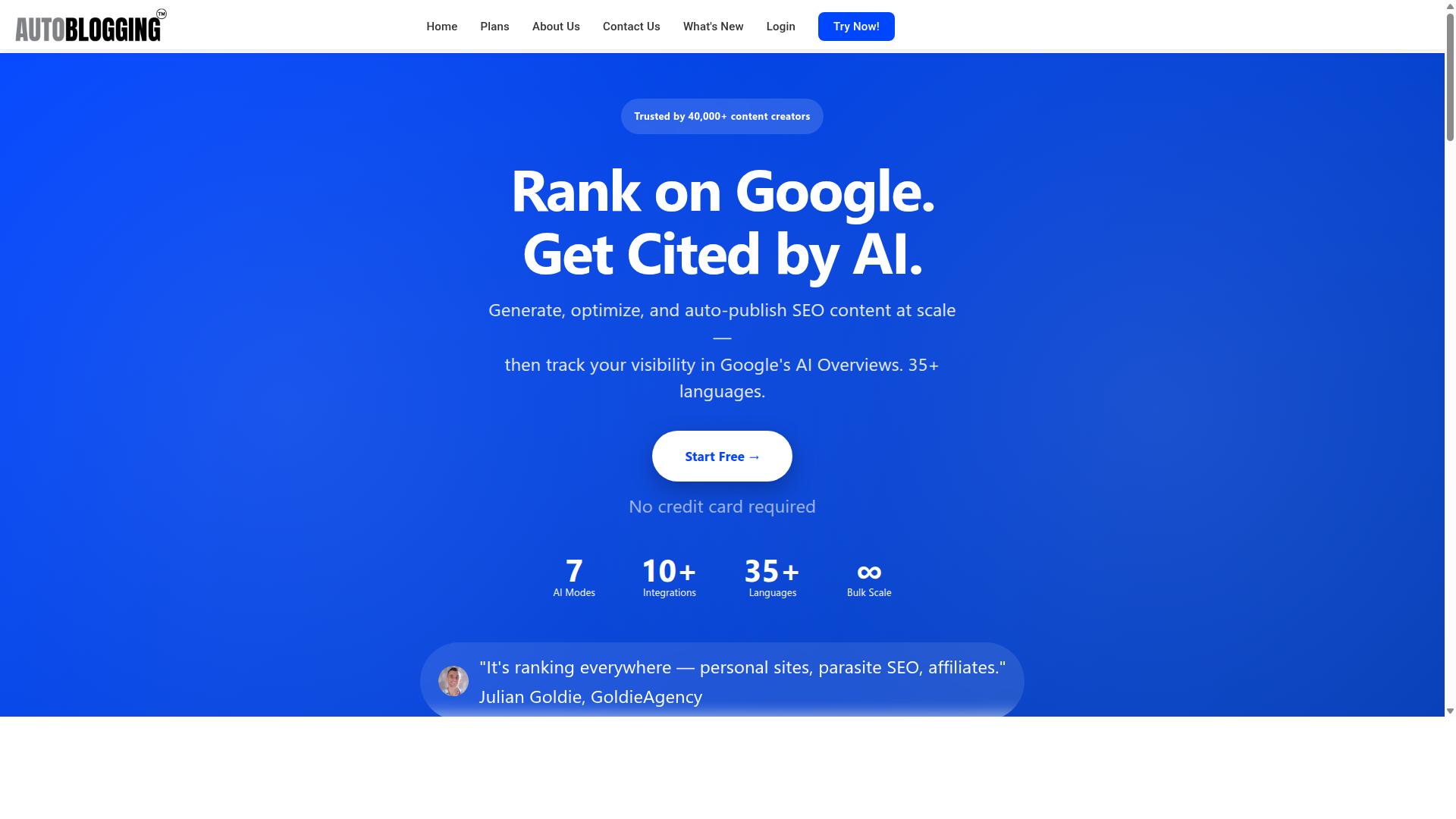
Autoblogging.ai is an AI-powered content generation platform that automates article creation and publishing across multiple content management systems. It is a SaaS product built by Digimetriq.com, founded in 2022 by Vaibhav Sharda.
The mission behind the platform is straightforward: help bloggers, website owners, and agencies save time and improve their online presence through cutting-edge technology. In practice, that means reducing content costs and giving human writers a strong first draft to work from inside their standard operating procedures. Digimetriq's longer-term aim goes further, toward replacing human counterparts entirely.
For anyone comparing CMS integrations, the core appeal is simple. Content automation tools like this one exist to remove the manual grind of writing and uploading articles one by one, which matters most for teams running niche sites, affiliate blogs, or programmatic SEO projects at scale.
Autoblogging.ai generates articles through two distinct approaches: Quick Mode and Godlike Mode. Quick Mode suits faster turnaround needs, while Godlike Mode targets longer, more detailed output. The platform also supports bulk generation of up to 500 articles in a single run and covers 35+ languages, which makes it viable for multilingual publishing strategies.
Adoption figures give a sense of its reach. Autoblogging.ai is used by 40,000+ content creators and has generated over 1 million articles to date. Those numbers reflect a tool that has moved past early adoption into everyday use across the blogging and agency world.
Where does this fit in a CMS integration discussion? A platform producing content at this volume needs reliable publishing pathways into systems like WordPress, Shopify, Wix, and others. The value of Autoblogging.ai in this context is not just article creation, but the ability to feed a publishing workflow without manual intervention at every step.
It is worth noting what Autoblogging.ai is not. It is not a plugin tied to a single content management system, and it is not a lightweight article spinner. It sits in the broader category of AI writing tools and natural language generation platforms, competing on output volume, language coverage, and generation modes rather than on being a niche add-on.
For readers weighing RankYak against Autoblogging.ai, this context matters. Understanding what Autoblogging.ai offers at its core, independent of any single CMS, sets up the more detailed integration comparison that follows.
What Is RankYak?
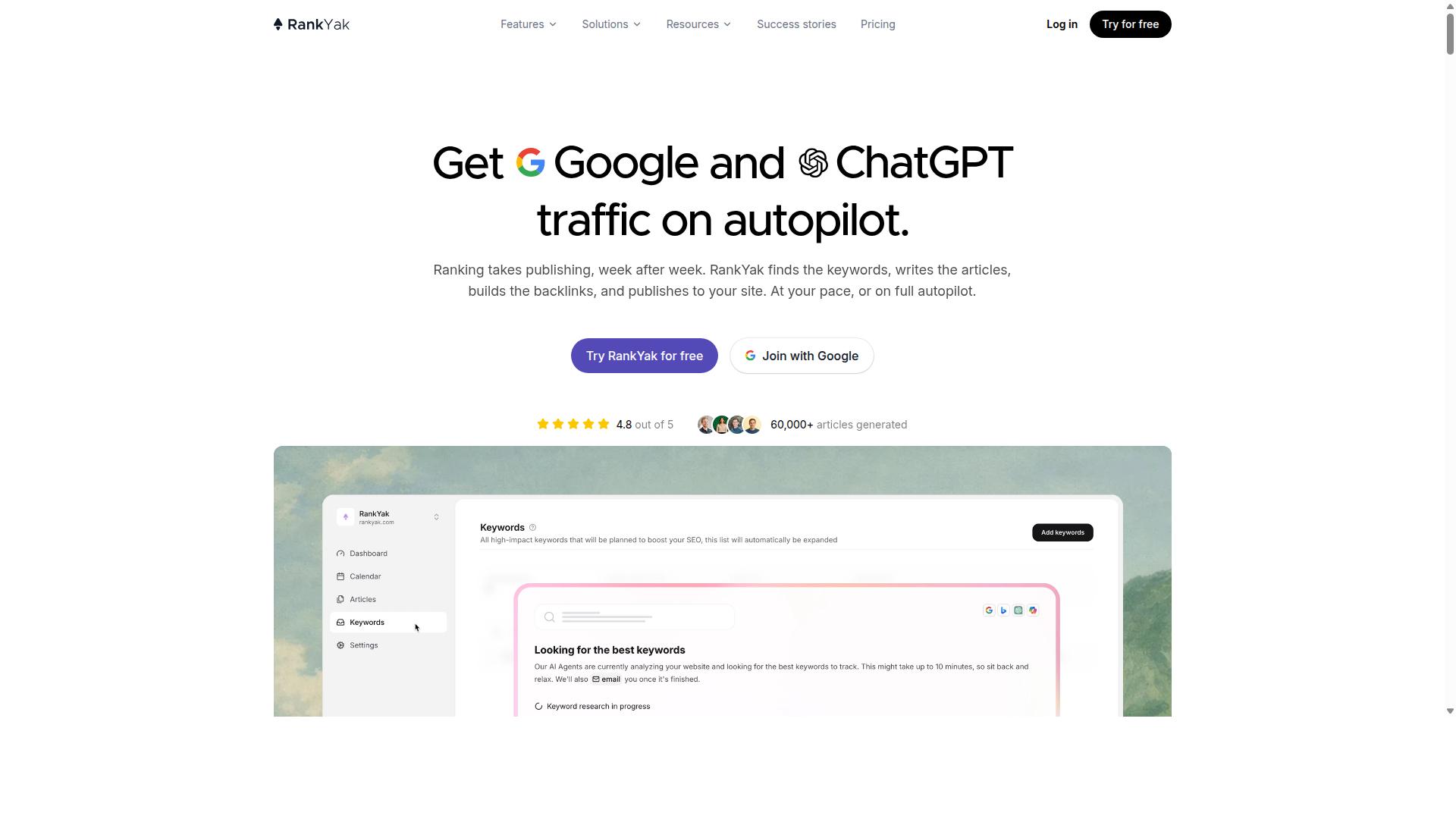
RankYak is an AI content automation tool designed primarily for WordPress users to generate and publish articles automatically. It sits in the same broad category as other AI writing tools that turn keywords into finished posts, then push those posts live on a site without heavy manual editing.
Its general positioning is simple and WordPress-centric. Rather than trying to serve every content management system on the market, RankYak appears to focus on the most common blogging setup, which is a self-hosted WordPress install connected through a plugin.
That narrow focus can be an advantage for beginners. A blogger who only runs one WordPress site may find the setup easier to understand than a platform built for many different CMS environments.
Based on publicly available information, RankYak may offer features such as keyword-based article generation, basic scheduling, and direct publishing to a connected site. These are common capabilities in the content automation space, though exact limits and options can vary by plan and change over time.
Where the tool tends to draw interest is blog automation for niche sites, affiliate marketing projects, and small content operations. Users in those categories usually want a steady flow of posts without writing each one by hand.
It is worth noting what RankYak does not appear to emphasize. There is little indication that it targets broad CMS integrations across platforms like Shopify, Wix, Squarespace, Webflow, Joomla, Drupal, Ghost, or HubSpot CMS. Its center of gravity stays on WordPress.
For readers comparing options, that distinction matters. A WordPress-only workflow is fine until a project expands to a second platform, a headless setup, or a client site running a different content management system. At that point, integration breadth becomes a deciding factor.
RankYak should therefore be understood as a focused, entry-level option rather than a universal publishing engine. It handles a familiar use case well, but its scope is narrower than tools built for multi-platform publishing workflows.
What Is Autoblogging.ai for CMS Integrations?
For CMS integrations, Autoblogging.ai provides a robust set of tools that connect with over 35 platforms, enabling automated publishing and content workflows. It is not simply an AI writer. It functions as a full content automation hub where article generation and publishing live in the same system.
That distinction matters for anyone running a content operation. Instead of generating articles in one tool and manually moving them into a content management system, the platform handles the handoff as part of the workflow. For agencies and multi-site owners, that removes a recurring bottleneck.
The integration list covers the platforms most teams actually use. Named connections include WordPress, Shopify, Wix, Webflow, Blogger, and Ghost, alongside Web 2.0 destinations such as Medium, Dev.to, Hashnode, Telegraph, and Tumblr. WordPress support is especially deep, with unlimited sites, one-click publishing, a plugin, and scheduled auto-posting.
Broader CMS coverage is handled through connection methods rather than one-off plugins. Autoblogging.ai offers an API, plus Zapier and n8n, which lets teams reach custom or less common systems without waiting for a native connector.
These connections support three practical publishing behaviors:
- Auto-publish, sending finished articles straight to a live site
- Draft mode, holding content for human review before it goes live
- Scheduling, spreading posts across a calendar instead of publishing in bursts
That combination is what separates a publishing hub from a standalone generator. Draft mode keeps editorial control intact, while scheduling supports steady output for blog automation and programmatic SEO projects.
For agencies managing client sites, the breadth is the real advantage. One workflow can serve a WordPress blog, a Shopify store, and a Webflow marketing site without switching tools. Multi-site owners get the same benefit at scale, since publishing rules can be applied across many properties rather than configured one by one.
| Integration Type | What It Enables |
|---|---|
| Native CMS connections | Direct publishing to WordPress, Shopify, Wix, Webflow, Blogger, and Ghost |
| Web 2.0 platforms | Distribution to Medium, Dev.to, Hashnode, Telegraph, and Tumblr |
| API access | Connecting custom or less common content management systems |
| Zapier and n8n | Building automated workflows across external apps |
In short, Autoblogging.ai treats CMS connectivity as a core feature rather than an afterthought. That makes it a strong fit for teams whose publishing needs span multiple platforms.
Features Compared
This section compares the core features of Autoblogging.ai and RankYak across CMS integrations, AI content generation, and scalability.
Autoblogging.ai offers a wider range of integrations and advanced AI modes, backed by features like SERP competitor analysis and semantic SEO tools. RankYak, by contrast, focuses on simplicity, particularly for WordPress users who want a straightforward publishing setup.
The three subsections below break down where each tool stands on connectivity, output quality, and long-term growth potential. The goal is to help you match a tool to your actual workflow, not just a feature list.
CMS Integrations and Publishing Workflow
Autoblogging.ai supports over 35 CMS integrations, including WordPress, Shopify, Wix, and HubSpot CMS, with flexible publishing options like draft mode and auto-publish. That breadth matters if you run content across more than one platform.
The named integrations also cover Squarespace, Webflow, Joomla, Drupal, and Ghost. Beyond traditional CMS platforms, it connects to automation tools such as Zapier and Make, and it offers a REST API and webhooks for custom setups.
- CMS platforms: WordPress, Shopify, Wix, Squarespace, Webflow, Joomla, Drupal, Ghost, HubSpot CMS
- Automation platforms: Zapier, Make
- Custom builds: REST API and webhooks
- Publishing controls: draft mode, auto-publish, and scheduling
For WordPress specifically, Autoblogging.ai supports unlimited sites with one-click publishing and scheduled auto-posting. You can generate content, schedule it, and either push it live or save it as a draft for review.
RankYak, on the other hand, primarily integrates with WordPress, typically through a plugin. It may not offer the same breadth of CMS connections or custom API options, so teams running multi-platform content operations may find it limiting.
AI Content Generation Modes and Output Quality
Autoblogging.ai offers multiple AI modes, including Quick Mode and Godlike Mode, which uses SERP competitor analysis and knowledge graph extraction for higher-quality output. Quick Mode is free and available in single and wizard formats for basic articles.
Godlike Mode targets advanced SEO-optimized content, pulling in LSI keywords and competitor signals to shape each piece. There are 10+ AI modes in total, including News Mode with Google News integration and Amazon Reviews Mode.
Bulk generation is a standout here, with support for up to 500 articles via CSV. That volume suits affiliate marketers and niche site operators who need consistent output without manual effort.
RankYak's AI generation is generally simpler, and it may rely on GPT-4 or a similar LLM for its output. Its feature set appears aimed at users who want quick drafts rather than deep optimization.
The practical difference comes down to output quality. Autoblogging.ai's Godlike Mode aims for human-like, SEO-friendly content, while RankYak may produce adequate but less optimized results. A human proofreader is also included in all Autoblogging.ai plans, which adds a layer of quality control that simpler tools often lack.
Optimization, Languages, and Scalability
Autoblogging.ai supports 35+ languages and offers scalability features like bulk generation up to 500 articles, making it suitable for programmatic SEO and large niche sites. Optimization tools include keyword research, SERP analysis, and LSI keyword integration.
The platform also provides a 21-point semantic SEO audit, a Snippet Optimizer for featured snippets, Topical Maps, and Fan Out Queries. These tools help structure content around search intent rather than just keywords.
Scalability extends to publishing too. With unlimited WordPress sites, scheduled auto-posting, and a Content Repurposer, the platform fits affiliate marketing and blog automation at volume. Credits rollover, which helps teams plan larger campaigns without waste.
RankYak may support multiple languages, though likely fewer than Autoblogging.ai. Its scalability may also be more limited, particularly for bulk content generation across many sites or platforms.
| Feature | Autoblogging.ai | RankYak |
|---|---|---|
| CMS integrations | 35+ platforms | Primarily WordPress |
| Languages | 35+ | Likely fewer |
| Bulk generation | Up to 500 articles via CSV | Limited scalability |
| SEO optimization | SERP analysis, LSI keywords, 21-point audit | Generally simpler |
| API and webhooks | Yes, plus Zapier and Make | May not offer |
For readers weighing CMS integrations against long-term growth, Autoblogging.ai covers more ground on both fronts. RankYak remains a reasonable entry point for simple WordPress blogs, but it may struggle as content operations expand.
Pricing Compared
Autoblogging.ai offers monthly plans starting at $19 for 40 credits, while RankYak's pricing structure is less transparent but generally positioned as a budget option.
For anyone comparing AI writing tools for CMS integrations, pricing clarity matters as much as the feature list. Autoblogging.ai publishes its tiers openly, and every plan includes credits rollover, so unused capacity does not simply vanish at the end of a billing cycle.
| Plan | Monthly Price | Credits | Annual Price |
|---|---|---|---|
| Starter | $19 | 40 | $12/mo ($148/year) |
| Regular | $49 | 120 | $32/mo ($382/year) |
| Standard | $99 | 300 | $64/mo ($772/year) |
| Gold | $179 | 600 | $116/mo ($1,396/year) |
| Premium | $249 | 1,000 | $162/mo ($1,942/year) |
| Enterprise | $999 | 5,000 | $649/mo ($7,792/year) |
Annual billing cuts the effective monthly rate considerably. The Starter plan drops from $19 to $12 per month, and the Enterprise tier falls from $999 to $649 per month when billed yearly. New accounts also receive 10 free credits per month with no credit card required, which lets you test the publishing workflow before committing.
Additional credits can be purchased separately, and payments are accepted via Visa, MasterCard, American Express, and PayPal, with bank transfers available for annual enterprise plans through Stripe. Cancellation is available at any time. For teams running bulk content generation across several CMS properties, that flexibility keeps costs predictable.
RankYak's pricing is not publicly detailed in a comparable way, and it varies depending on the plan or arrangement you choose. It is often described as a budget-friendly option, particularly for straightforward WordPress automation. That positioning can appeal to solo bloggers who only need basic scheduling and publishing.
Because RankYak's published numbers are not consistently available, a direct dollar-for-dollar comparison is difficult to make with confidence. What can be assessed is scope. Autoblogging.ai bundles more features and CMS integrations into each tier, which matters when your setup extends beyond a single WordPress install. For a fair judgment, map your own requirements first: how many sites, how many articles per month, and which platforms you publish to. If you only need light WordPress automation, a cheaper tool may cover it. If you need content automation across multiple systems with credits that carry over, Autoblogging.ai's published tiers make the cost easier to plan around.
Who Should Choose Autoblogging.ai
Autoblogging.ai is ideal for bloggers, SEO professionals, and agencies that need extensive CMS integrations and scalable content generation. The platform was built for people who publish across more than one site or more than one content management system, and that focus shapes everything from its integration list to its publishing workflow.
With 35+ integrations, Autoblogging.ai covers the platforms most publishers actually use, including WordPress, Shopify, Wix, Squarespace, Webflow, Joomla, Drupal, Ghost, and HubSpot CMS. For anyone running a single blog, that breadth may look like more than you need. For anyone running five sites on three different platforms, it is the difference between one workflow and three.
The target audience is broad but specific in its needs:
- Bloggers and website owners who want consistent publishing without writing every post by hand
- SEO professionals managing SEO content across client or personal properties
- Marketing agencies serving clients on different platforms
- Content creators and affiliate marketers building niche sites and affiliate sites
- Portfolio and local site operators who need steady output on a small team
Agencies feel the integration gap most sharply. When every client sits on a different content management system, a tool that supports only one platform forces you into manual exports, copy-paste publishing, or a second subscription. Bulk content generation compounds the benefit: producing articles at scale only pays off if those articles can actually reach every site you manage.
Autoblogging.ai also backs the platform with 24/7 support and weekly feature updates. For teams running content automation as an ongoing operation rather than a one-off experiment, that combination matters. Support questions rarely arrive during convenient hours, and a tool that ships improvements every week is less likely to fall behind the platforms it connects to.
If your work involves multiple sites, diverse CMS platforms, or client properties spread across different systems, Autoblogging.ai is the more natural fit. The integration count and bulk generation are not extras here. They are the core reason this audience chooses it.
Who Should Choose RankYak
RankYak is best suited for individual bloggers or small site owners who use WordPress exclusively and want a simple, budget-friendly automation tool. If your entire publishing operation lives on one WordPress install and you mainly need help producing articles on a steady schedule, a lightweight tool may cover your needs without much setup friction.
For this type of user, the appeal is straightforward. A single-site tool is likely easier to configure and may cost less than a platform built for broader CMS integrations. Beginners who find plugin dashboards intimidating often prefer a narrower feature set that does one job without extra configuration screens.
RankYak may also fit people who treat content automation as a side project rather than a core business function. A hobby blog, a personal niche site, or a small affiliate project can often run on basic scheduling and draft publishing alone. In those cases, paying for multi-platform support would be wasted spend.
Typical RankYak users tend to share a few traits:
- They run a single WordPress site and have no plans to expand to other platforms.
- They are new to content automation and prefer a minimal learning curve.
- They publish at a modest pace and do not need bulk content generation at scale.
- They handle publishing manually or through simple scheduling rather than complex workflows.
- They prioritize low cost over advanced integrations.
The trade-off is capability. A tool focused on one platform is unlikely to offer the same breadth as a platform built for CMS integrations across WordPress, Shopify, Wix, Squarespace, Webflow, Joomla, Drupal, Ghost, and HubSpot CMS. Users who later add a second site on a different content management system may find themselves looking for a new solution.
Advanced needs also tend to expose limits. REST API access, webhook support, and connections through automation platforms like Zapier or Make are the kinds of features that matter once publishing workflows grow. A simpler tool may not include them, and that gap becomes noticeable when you want auto-publish rules, draft mode control, or programmatic SEO at volume.
So the honest summary is this: RankYak is a reasonable entry point for a beginner with one WordPress blog and a tight budget. It is not the stronger choice for anyone planning to scale across multiple platforms, run bulk content generation, or build a publishing workflow that depends on deeper CMS integrations. Readers in that second group should weigh a broader platform more carefully before committing.
Who Should Choose Autoblogging.ai for CMS Integrations
If your workflow involves multiple CMS platforms such as WordPress, Shopify, and HubSpot CMS, Autoblogging.ai is the clear choice due to its extensive integration library. RankYak's approach leans heavily toward WordPress, which works well for a single-site blogger but creates friction for anyone managing content in more than one place.
Autoblogging.ai supports 35+ integrations, and that breadth changes what is possible for teams that cannot standardize on one system. Instead of rebuilding a publishing routine for every platform, you connect once and let the automation handle distribution.
Three groups tend to benefit most from this setup:
- Agencies managing client sites across different systems, where each client may use a different CMS.
- Multi-site owners running portfolios that mix platforms for different audiences or niches.
- Niche CMS users on Ghost, Joomla, or similar systems that mainstream AI writing tools often overlook.
For these users, the deciding factor is not article quality alone. It is whether the tool can actually deliver finished content to every destination in the stack without manual copy-paste work.
Autoblogging.ai covers publishing through a WordPress integration with unlimited sites, plus multi-platform support for Shopify, Wix, Webflow, Blogger, and Ghost. It also publishes to Web 2.0 destinations including Medium, Dev.to, Hashnode, Telegraph, and Tumblr.
Beyond built-in connections, the platform offers an API, Zapier, and n8n support. That combination matters for teams with custom stacks or internal tools. A REST API integration or webhook lets developers push generated content into a proprietary content management system, while Zapier and n8n connect the workflow to hundreds of other apps without custom code.
RankYak's WordPress-centric design may not fit this kind of environment. For a solo blogger on WordPress, the narrower focus is rarely a problem. For an agency juggling five client sites on five different platforms, it becomes a daily obstacle.
Publishing volume is the other half of the equation. Autoblogging.ai includes bulk generation of up to 500 articles via CSV, along with content scheduling and auto-publish options. A multi-site owner can queue a batch of articles, assign them across platforms, and let the publishing workflow run on a schedule rather than logging into each dashboard separately.
This is where content automation stops being a convenience and starts being infrastructure. Programmatic SEO projects, affiliate marketing portfolios, and blog automation networks all depend on consistent output across many properties. Manual publishing does not scale to that level, and a tool tied to one CMS cannot either.
To summarize the fit:
| User Type | Why Autoblogging.ai Fits |
|---|---|
| Agencies with mixed client CMS | 35+ integrations plus API, Zapier, and n8n cover varied stacks |
| Multi-site owners | Unlimited WordPress sites, multi-platform publishing, scheduling |
| Ghost, Joomla, or niche CMS users | Named support for Ghost and other non-WordPress platforms |
| High-volume publishers | Bulk generation up to 500 articles via CSV |
If your publishing footprint is a single WordPress blog, either tool can likely serve you. If it spans several platforms, several client accounts, or several hundred articles, Autoblogging.ai's integration depth and bulk capabilities make it the more practical choice for CMS integrations.
Final Verdict
For most users needing robust CMS integrations and scalable content automation, Autoblogging.ai is the superior choice, though RankYak remains a viable option for simple WordPress setups.
The comparison comes down to breadth versus simplicity. Autoblogging.ai is built for anyone who needs to publish across multiple platforms, manage several sites, or scale content output over time. RankYak covers the basics for a single WordPress blog, and that narrower focus is fine for a hobby site or a first project. Beyond that scope, its limits become harder to ignore.
Autoblogging.ai's advantages show up in three areas that matter for CMS integrations:
- Integrations: support for a wider range of content management systems, including WordPress, Shopify, Wix, Squarespace, Webflow, Joomla, Drupal, Ghost, and HubSpot CMS, plus plugin, API integration, REST API, and webhook options.
- Features: bulk content generation, content scheduling, draft mode, auto-publish, SEO content workflows, and programmatic SEO support for niche sites and affiliate marketing projects.
- Scalability: a platform designed for agencies, multi-site owners, and teams running blog automation across diverse CMS environments.
Those strengths are backed by a user base of 40,000+ users and a 4.9 rating, which signals that the platform holds up for real publishing workflows, not just demos.
RankYak is adequate for basic WordPress automation. If you run one WordPress site and only need straightforward scheduling, it can get the job done. But it lacks the breadth that agencies and multi-site operators need, and it offers little for anyone working with Shopify, Webflow, HubSpot CMS, or other non-WordPress systems.
Here is the short version of who should choose what:
| User Type | Recommended Choice | Why |
|---|---|---|
| Agencies managing client sites | Autoblogging.ai | Wide CMS integrations and bulk content generation |
| Multi-site owners | Autoblogging.ai | Scalable content automation across platforms |
| Users on diverse CMS | Autoblogging.ai | Support for WordPress, Shopify, Wix, Squarespace, Webflow, Joomla, Drupal, Ghost, and HubSpot CMS |
| Single WordPress blog, just starting | RankYak | Adequate for basic WordPress automation |
If your goal is content automation that grows with you, Autoblogging.ai is the safer long-term investment. If you only ever plan to run one WordPress site with light publishing needs, RankYak might suffice.
For questions before you decide, Autoblogging.ai is reachable through several channels. In India: 501, Trinity Orion, Vesu, Surat 395007, Gujarat, India. Phone or WhatsApp: +91 84605-06553 or +91-8460506553. Email: vaibhav@autoblogging.ai. Skype: vibes.yb. Support hours are 7:00 to 19:00 IST. In the United Kingdom: 2nd Flr, SEO Content Suite, 35 Water Ln, Wilmslow, Cheshire SK9 5AR. Phone: +44 1625 359056. You can also follow Autoblogging.ai on Facebook, Twitter, and LinkedIn for updates.
Frequently Asked Questions
What makes Autoblogging.ai a strong choice for CMS integrations?
Autoblogging.ai is built to fit into the tools you already use, offering 35+ integrations so generated content can flow into your CMS and publishing workflow. It's trusted by 40,000+ content creators and backed by 24/7 support, with new features shipped weekly. If publishing efficiency is your priority, that breadth of integrations plus continuous updates is a major advantage.
Does Autoblogging.ai offer a free plan or trial so I can test CMS integrations before paying?
Yes. Autoblogging.ai includes a free plan with 10 credits a month and no card required, so you can explore the platform and its integrations before committing. Paid plans start at $19/month for 40 credits and scale up to the Enterprise plan at $999/month for 5,000 credits. Annual billing saves 35%, and unused credits roll over.
How does RankYak's pricing compare to Autoblogging.ai's?
RankYak Pro is listed at $99 per month, or $82.50 per month billed yearly, with Site Guard also at $99 per month and a 3-day full-access free trial. Autoblogging.ai takes a credit-based approach instead, with plans ranging from a free tier and $19/month Starter up to $999/month Enterprise, plus 35% savings on annual billing. The better fit depends on whether you prefer a flat monthly rate or credit-based scaling.
Which platform handles bulk content generation for CMS publishing better?
Autoblogging.ai supports Bulk Generation of up to 500 articles via CSV, which is designed for pushing large volumes of content into your publishing pipeline. It also offers 10+ AI modes, including Godlike Mode with SERP competitor analysis and knowledge graph extraction, and supports 35+ languages. That combination makes it well suited to agencies and site owners managing content at scale.
Can Autoblogging.ai support agencies managing multiple client CMS sites?
Yes. Autoblogging.ai is used by marketing agencies, SEO professionals and affiliate marketers, and serves client websites, portfolio sites and local sites alongside personal blogs. With credits that roll over, bulk generation and 35+ integrations, agencies can manage multiple sites without losing unused capacity. RankYak also offers an Agency Partner option where every client site is priced the same as the first, so both platforms cater to agency workflows in different ways.
What kind of support and reliability can I expect from Autoblogging.ai?
Autoblogging.ai provides 24/7 support and ships new features weekly, with a 4.9 average rating and 1M+ articles generated to date. It's a product of Digimetriq.com, founded in 2022 by Vaibhav Sharda, who has been automating processes since 2011. For teams relying on CMS integrations daily, that track record and ongoing development matter.
Recommended Resources: